
很久没写博客 好像也不知道要写什么了
Monday, January 2, 2023

Monday, May 4, 2015
Subconscious City
In a
world where we are being constantly bombarded by more and more stimuli, many
things go unnoticed. Subconscious memory retains this unnoticed information,
though it is often unattainable. In an examination of the relationship between
the conscious and subconscious, it was found that those faces, buildings, and
miscellaneous objects we fail to appreciate can have as much an impact on our thinking patterns as those about which we are acutely aware.
Subconscious
information is often related and connected to consciousness in the form of
dreams. Fragmented information from both worlds comes together to form seemingly
nonsensical stories as these connections are made. Unfortunately, even this
representation of the subconscious is often forgotten and unattainable.
Dream
Link attempts to merge consciousness and subconsciousness through a thorough
record of both, blatantly pointing out the connected thoughts, ideas, faces and
buildings so that the user may interpret those connections for him or herself. More broad knowledge of our own mental activity would allow us to have a greater
self awareness, which would lead to improved future experiences with heightened
alertness to the world around us.
Friday, May 1, 2015
Haptic Connections
“The brain does not live inside the head, even though it is
its formal habitat. It reaches out to the body, and with the body reaches out
to the world… brain is hand and hand is brain.”
This quote from Juhani Pallasmaa’s The Thinking Hand describes the human connection to the environment
and surrounding through the touch of the hand. The sense of touch is a powerful
instrument; the human brain is stimulated by the textures, temperatures, and
simple feel of the world around it, and in turn the world around a person can –
through touch – affect a person’s thoughts, perceptions, and memories.
In our society today, the hand-held device has become the
world in which we are involved; although it is a powerful tool, it sometimes
serves as a distraction from the physical world around us. By using the phone
as a tool to record and map the things our hands encounter in our environment,
we can reconnect to our surroundings and become more aware of the haptic effect
it has on our consciousness and psyche.
Write the City
Wik is a platform for discovery - a tool that allows the user to view the unseen consciousness of the city. Using advanced speech recognition software, Wik compiles a meta-narrative based on input from all participating user’s devices. The user can then “read” this narrative which is essentially a city-wide dialogue map - a section of the city. Dialogue mapping is the process of diagramming group conversations in order to create a shared understanding of complex problems and facilitate constructive solutions to these problems. These once unsolvable and sometimes unrecognized problems, also called “wicked problems,” are identified and analyzed by the group using Wik.
The
key to the success of dialogue mapping, and Wik, is the shared display. Wik
leverages the shared display we carry in our pockets and purses every day. By
viewing the narrative on the shared display, once individual perceptions will
shift into a collaborative mode. The narrative and shared display also
functions to compress time, allowing the group of users to better understand
the problems, solutions and perceptions of the inhabitants of the city.

Design an APP about WATER
Keeping track of soil moisture during your daily life by using a smartphone is an effective way to analyze how moist your living environment is.
It's so easy to use, just turn your phone on and run the application, touch the camera gently on the soil sample obtained from your testing location and see the result after a few seconds. The data can be saved in a incomplete moist map that is created by your own.
In addition, a huge database on habitats helps you understand how water impact lives. For some professionals, it is also a good tool helping them how to treat and develop the lands in the project areas properly.
It's so easy to use, just turn your phone on and run the application, touch the camera gently on the soil sample obtained from your testing location and see the result after a few seconds. The data can be saved in a incomplete moist map that is created by your own.
Thursday, April 30, 2015
Somethings About Your Fingerprint
The human fingerprint is one of the most unique physical attributes we have. What if this unique identification also could serve as a gateway to what we truly are as humans beings as we interact and inhabit the earth? There is definitely something to consider about our fingerprint.
Experimenting with an app idea.
Wednesday, April 29, 2015
Breathe of the City and the Body
The Breathe App allows the user to log the amount of pollutant that they are breathing in a particular city. This not only logs your location, but it logs the time and date to let the user know the peak seasons or time that air contamination is lower or higher. The user can also compare the amounts of impurities in their city to a friend in a different city. With the GPS abilities, the user is able to see what parts of the city that are more densely polluted. With this tool, we the public, can learn about how the air quality affects everything in your body.
Breathe also teaches the user about air contamination and how we can slow the rate of global warming. This tool is an integrated way the user can learn about the causes of pollution, how to stop the quality of the air from getting worse, and learn about the little everyday things that can be done to help the environment for the short run and long run. We all live on this great Earth and we all need to do our part to keep this planet clean and healthy for the future.
Tuesday, November 25, 2014
Water Drawings of Invisible Things


I have come across two projects that use water as a medium for visualizing what is invisible: in this case, soundwaves and brainwaves. In the work of Nigel Stanford, Cymatics [the study of visible sound] auditory compositions are translated into visual geometric patterns moving in water. In Lisa Park's project, Eunioa [beautiful thinking], her brainwaves are translated into sound vibrations also reverberating as water patterns, changing and moving as her thoughts transform. Her project is of particular interest in the topic of CiTy SCAN [the intricate relationship between the human body and the city body]. To bring the scale of the city to this, I recall Siegfried Kracauer as he described the memory of the first film that he saw; "What thrilled me so deeply was an ordinary suburban street. Filled with lights and shadows, which transfigured it. Several trees stood about and there was in the foreground a puddle reflecting invisible house facades and a piece of sky. Then a breeze moved the shadows, and the facades with the sky below began to waver."
top image: still from Lisa Park's video Eunioa
bottom image: still from Nigel Stanford's video Cymatics
Monday, May 6, 2013
Familyography
Familyography
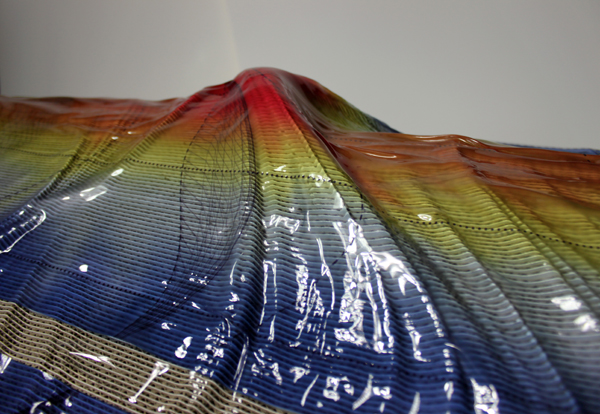
Visualizing
a Portrait of Tactile, Chromatic and Audible Definitions
Abstract
While
physical geographies and personal differences dictate our daily schedules,
truly we are all running together, experiencing life in parallel. A family portrait is visualized in three
perceptions to extend the efforts of the traditional still-photography, family
portrait. These perceptions are crafted
from the physiological arousal of individual family members throughout their
daily routines. Activity and emotion are
combined with the visualizations of a family, created through a topographic
surface (a tactile experience), a field of color (a two dimensional reading),
and a composition of sound (an engaging, space activating interaction). This is our experience, a familyography, visualized
through an emotivescape, chromascape, and phonoscape (or, that of topography,
color, and sound).


Friday, May 3, 2013

Monday, March 25, 2013
Wednesday, March 13, 2013
OBcities

Dr. David Suzuki says it best, “With an estimated population of nine billion people by 2050, we cannot continue to consume resources at the same rate and maintain our quality of life.” We have become an obese race, rapidly consuming even more than we physically can. This consumption is occurring at an alarming rate with no regard for the effects that our actions have not only on the health of environment but also indirectly on the health of current and future generations. Society is becoming more diseased and overweight everyday. I am considering further researching this topic through my seminar project for Urban CT. I would like to use the CT as a new lens to look at the parallel between healthy cities and healthy bodies.
"David Suzuki Foundation | Solutions Are in Our Nature." David Suzuki Foundation. N.p., n.d. Web. 13 Mar. 2013.
Tuesday, March 12, 2013


Monday, March 11, 2013
fragmented visioning
fragmentary visioning from Joshua Atria on Vimeo.
The video was captured through the aid of an iphone strapped to my leg. This unique perspective overlaps the sinusoidal patterning of the dynamic (caused by the motion of the leg) with the visual patterning of the static (the painted lines in the road, trees, etc). Inspired by the excerpt below from Siegfried Kracauer's, "Once Again the Street."
"The Street in the extended sense of the word is not only the arena of fleeting impressions and chance encounters but a place where the flow of life is bound to assert itself....The kaleidoscopic sights mingle with unidentified shapes and fragmentary visual complexes and cancel each other out, thereby preventing the onlooker from following up any of the innumerable suggestions they offer. What appears to him are not so much sharp-contoured individuals engaged in this or that definable pursuit as loose throngs of sketchy, completely indeterminate figure. Each has a story, yet the story is not given. Instead, an incessant flow of possibilities and near-intangible meanings appears."
Wednesday, March 6, 2013
Robotic Acceleration
robotic acceleration from Dan Hutcherson on Vimeo.
I see this as a translation of my acceleration through a robotic tool, a large format cutting table. Video and acceleration is captured in three directions to illustrate the mechanical motion.Tuesday, March 5, 2013
CT-scan and Reflexology
The purpose of this video is exposing the hidden connections between the city infrastructure and the foot reflexology. In traditional Chinese medical science, the subtle relationship between the inner body system and outer physique can be reflected through the acupuncture points. This practice of theory has been widely applied into body massage treatment, such as foot and hand. The fact that cities are constructed by hard and soft infrastructure is fairly similar to the human body’s internal and external organs. Based on a brief study of the foot reflexology diagram, the reflex zones can be divided into two parts; one being the internal organs, such as brain and nerves, while the other one being the external organ, such as ear and eye. In this video, the urban soft infrastructure can be understood as things that involved human cultural efforts (graffiti, sculpture, etc.) or natural elements (plants, animals, etc.), while the urban hard infrastructure are things that are essential in constructing a city (road, bridge, building, etc.).
Thursday, February 28, 2013
Subscribe to:
Posts (Atom)